
Baking Pan Conversion Calculator
Cake Pan Size Converter
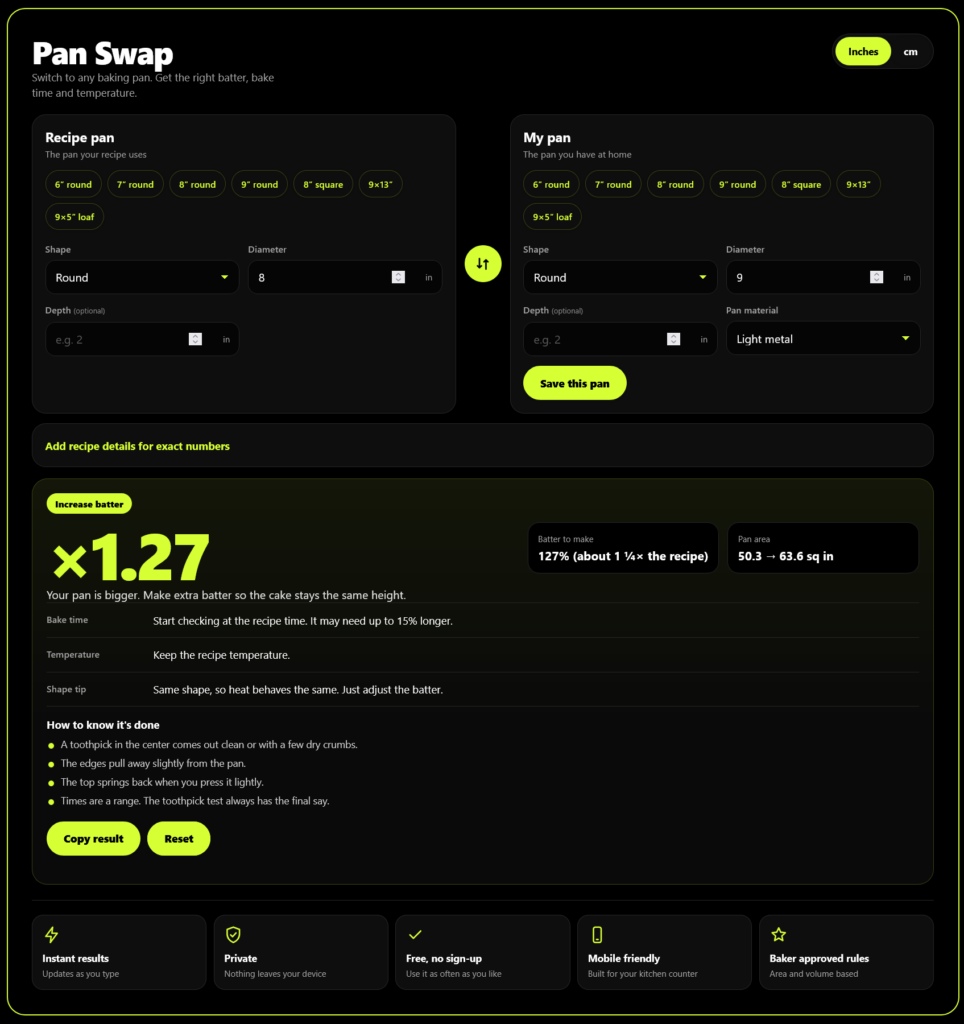
Pan Swap
Switch to any baking pan. Get the right batter, bake time and temperature.
Recipe pan
The pan your recipe uses
My pan
The pan you have at home
Add recipe details for exact numbers
Enter a size for both pans to see your result.
- Eggs
- Bake time
- Temperature
- Shape tip
- Your ingredient
How to know it's done
- A toothpick in the center comes out clean or with a few dry crumbs.
- The edges pull away slightly from the pan.
- The top springs back when you press it lightly.
- Times are a range. The toothpick test always has the final say.
Cake Pan Size Converter
Easily convert your cake pan sizes and get the right amount of batter, eggs, bake time and temperature.
How to use this baking pan conversion calculator
Follow these five simple steps to convert your baking pan size, adjust the batter and get the right baking time.
Set the recipe pan.
Tap a quick size such as 8″ round, or choose the shape and type in the diameter, or the length and width.
Set your pan.
Do the same for the pan you have at home, and pick its material (light metal, dark metal or glass).
Add depth if you know it.
When both depths are entered, the calculator compares volume instead of surface area.
Open "Add recipe details".
Enter the eggs, bake time and oven temperature from your recipe, plus any ingredient amount you want scaled.
Read the result.
You get the multiplier, the batter to make, the egg adjustment and a bake time range. Tap "Copy result" to save it, or "Save this pan" to keep your pan for next time.
How do you convert
baking pan sizes?
To convert baking pan sizes, divide the area of your pan by the area of the recipe pan. The result is your multiplier. A 9-inch round pan (63.6 sq in) divided by an 8-inch round pan (50.3 sq in) gives ×1.27, so you need about 27% more batter to keep the same cake height.
9″ round ÷ 8″ round = ×1.27 (make about a quarter more batter)
8″ square and 9″ round have almost the same area, so they can be swapped as is
9×13″ is about 1.8 times the size of a 9″ round pan
Always finish with the toothpick test, because depth and pan material change the bake time
Popular pan swaps and their multipliers
Use these common baking pan swaps to quickly adjust your batter when changing from one pan size to another.
| Recipe pan | Your pan | Multiplier | What to do |
|---|---|---|---|
| 8″ round | 9″ round | ×1.27 | Make about 27% more batter |
| 9″ round | 8″ round | ×0.79 | Use about 79% of the batter |
| 8″ square | 9″ round | ×0.99 | Use the recipe as written |
| 9″ round | 8″ square | ×1.01 | Use the recipe as written |
| 8×8″ square | 9×9″ square | ×1.27 | Make about 27% more batter |
| 9×9″ square | 9×13″ | ×1.44 | Make about 44% more batter |
| 9×13″ | 8×8″ square | ×0.55 | Roughly half the recipe |
| 9″ round | 9×13″ | ×1.84 | Nearly double the recipe |
| 9×13″ | two 9″ rounds | ×1.09 | Use the recipe as written |
| 7″ round | 8″ round | ×1.31 | Make about 31% more batter |
| 8″ round | 6″ round | ×0.56 | Use a little over half |
| 20 cm round | 23 cm round | ×1.32 | Make about 32% more batter |
Multipliers are based on surface area and assume the batter should end up the same depth as in the original pan.
Baking pan size chart: area in square inches and cm
Compare common baking pan sizes by area in square inches and centimetres to choose the closest match for your recipe.
| Pan | Area (sq in) | Metric size | Area (sq cm) |
|---|---|---|---|
| 6″ round | 28.3 | 15 cm round | 176.7 |
| 7″ round | 38.5 | 18 cm round | 254.5 |
| 8″ round | 50.3 | 20 cm round | 314.2 |
| 9″ round | 63.6 | 23 cm round | 415.5 |
| 10″ round | 78.5 | 25 cm round | 490.9 |
| 8×8″ square | 64.0 | 20×20 cm square | 400.0 |
| 9×9″ square | 81.0 | 23×23 cm square | 529.0 |
| 9×13″ rectangle | 117.0 | 23×33 cm rectangle | 759.0 |
Metric sizes are the nearest common pan sizes, so they may differ slightly from the inch version.
The maths behind a cake pan size converter
A cake pan size converter works on area, not on the number printed on the pan. A pan that looks only slightly wider holds a lot more batter, because area grows with the square of the width.
Worked example: an 8-inch round pan has an area of 50.3 sq in and a 9-inch round has 63.6 sq in. 63.6 ÷ 50.3 = 1.27. Multiply every ingredient by 1.27 and the batter sits at the same depth in the larger pan.
If you know the depth of both pans, multiply each area by its depth and divide the volumes instead. This is the most accurate method for deep pans, loaf pans and springform pans.
How to adjust eggs, bake time and temperature
Scale your recipe correctly while keeping the cake depth, texture and baking results consistent.
Eggs
Scaled recipes rarely give a whole number of eggs. Beat an egg and measure it: one large egg is about 3 tablespoons (roughly 50 g) beaten. If a recipe uses 3 eggs and the multiplier is ×1.27, you need 3.8 eggs. Use 3 whole eggs plus about 2½ tablespoons of beaten egg.
Bake time
When you scale the batter to match the new pan, the cake keeps the same depth, so start checking at the recipe time. Larger batches can need up to about 15% longer, and smaller ones are usually ready 10% to 20% sooner.
If you do not scale the batter, the cake spreads thinner and bakes faster. One baking reference gives the example of a cake that takes 25 minutes in an 8-inch pan but may be done in about 20 minutes in a 9-inch pan.
Temperature
Keep the recipe temperature in a light metal pan. For dark, non-stick or glass pans, lower the oven by about 25°F (15°C) because they absorb more heat and brown the edges faster.
How to tell it is done
Check these signs before removing the cake.
- ✓ A toothpick in the centre comes out clean or with a few dry crumbs
- ✓ The edges pull away slightly from the pan
- ✓ The top springs back when pressed lightly
Why This Tool Is Better Than Other PDF Tools
Unlike many popular PDF platforms such as iLovePDF, and Adobe Acrobat Online, this tool freeconvertzo is designed with a simpler, privacy-first experience — so you can complete your PDF task without unnecessary signup steps, complicated interfaces, or waiting for cloud processing. Instead of sending your files to a remote server, browser-based processing can keep your documents on your own device, making the workflow faster, more private, and convenient. Whether you need to add a password, edit, convert, compress, or manage a PDF, this tool focuses on free access, no-watermark output, simple controls, and instant results without making users navigate through unnecessary features or account requirements.
FAQ
Frequently Asked Questions
Can I use a 9-inch pan instead of an 8-inch pan?
Yes. A 9-inch round pan has about 27% more area than an 8-inch one. Multiply the recipe by 1.27 to keep the same cake height, or use the original batter and expect a thinner cake that bakes faster. A baking pan conversion calculator gives the exact multiplier.
How do I convert a cake recipe to a different size pan?
Divide the area of your pan by the area of the recipe pan, then multiply every ingredient by that number. Round area is π × radius², square area is side × side and rectangle area is length × width. A cake pan size converter does this in one step.
Can I use a 9×13 pan instead of a 9×9 pan?
Yes, but a 9×13 pan is about 44% larger (117 sq in against 81 sq in). Multiply the recipe by 1.44 to keep the same depth. If you use the original batter, it will spread thin and bake faster, so check early.
Can I use an 8×8 pan instead of a 9×13 pan?
Yes, if you halve the recipe. An 8×8 pan is 64 sq in and a 9×13 pan is 117 sq in, so the multiplier is ×0.55. Use that much batter and bake until the toothpick comes out clean.
How do I adjust baking time when I change the pan size?
If you scale the batter to the new pan, start checking at the recipe time. If you keep the same batter, a larger pan makes a thinner cake that can be done 10 to 15 minutes sooner, while a smaller pan makes a deeper cake that needs extra time in 5-minute steps. Always finish with a toothpick test.
How do I measure a cake pan?
Measure across the inside of the pan from one inner edge to the opposite inner edge. For a rectangle, measure the inside length and width. Measure the depth from the base to the rim. Do not measure the outside, because the rim makes the pan look bigger than its real baking area.