
Yeast to sourdough conversion calculator
baker's percentage calculator
Free yeast to sourdough conversion calculator and baker’s percentage calculator. Swap yeast for starter and get exact grams, hydration and timing instantly.
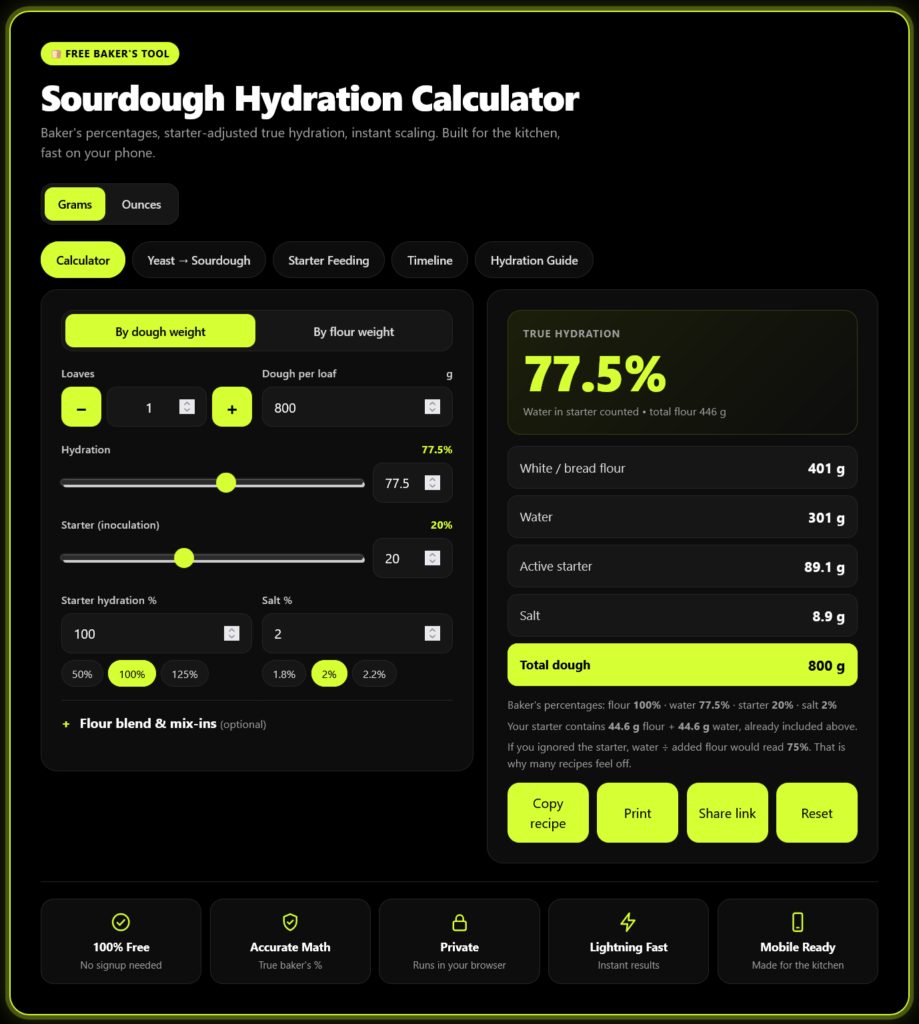
Sourdough Hydration Calculator
Baker's percentages, starter-adjusted true hydration, instant scaling. Built for the kitchen, fast on your phone.
Flour blend & mix-ins (optional)
The rest of your flour is white / bread flour. Your starter is assumed to be made with white flour.
Enter the flour and liquid from your yeast recipe. Starter is calculated as a percentage of the recipe flour. Leave out the yeast.
Estimates only. Flour, starter strength and dough temperature change real timings. Always judge by the dough, not the clock.
Bagels, pretzels, tight crumb. Easy to shape.
Holds shape well. Great for your first loaves.
Balanced crumb, manageable handling.
Airy and glossy. Needs stronger dough handling.
Very open, sticky dough. Ciabatta-style results.
Whole wheat and rye absorb more. Add 5–10% hydration.
Yeast to Sourdough Conversion Calculator (Quick Answer)
To convert a yeast recipe to sourdough, remove the yeast, add active starter equal to about 15–25% of the flour weight, and subtract the flour and water that the starter contains from the original recipe. Then allow a much longer rise. The calculator above does all of this automatically.
Step-by-Step: How to Convert
Weigh your flour and liquid in grams.
Remove the yeast from the recipe.
Choose a starter amount, usually 20% of the flour weight.
Subtract the starter's flour and water from the recipe.
Let the dough rise until it is airy and has grown, which takes longer than with yeast.
How to Use This Yeast to Sourdough Conversion Calculator
Open the Yeast → Sourdough tab.
Type the flour and the water or milk from your yeast recipe.
Set the starter percentage. Start with 20% if you are unsure.
Enter your starter hydration. Most home starters are 100%.
Read your new flour, water and starter amounts, then use Copy recipe or Share link to save them.
Prefer grams or ounces? Use the unit toggle at the top of the tool. The other tabs help with scaling, feeding and fermentation time.
Worked Example: Converting a Yeast Bread to Sourdough
Say your original recipe uses 500 g flour, 300 g water, 10 g salt and 7 g instant yeast. You choose 20% starter at 100% hydration. Here is how the yeast to sourdough conversion calculator handles it:
| Ingredient | Yeast recipe | Sourdough version |
|---|---|---|
| Flour | 500 g | 450 g |
| Water | 300 g | 250 g |
| Salt | 10 g | 10 g |
| Instant yeast | 7 g | 0 g |
| Active starter | 0 g | 100 g |
| Hydration | 60% | 60% |
The 100 g of starter brings 50 g flour and 50 g water, so total flour and water are unchanged. Hydration stays at 60%, which is why the dough should feel just like the original.
If your starter is stiffer, at 50% hydration, the same 100 g contains about 67 g flour and 33 g water. In that case the calculator shows roughly 433 g flour and 267 g water instead.
What Is a Baker's Percentage Calculator?
A baker's percentage calculator expresses every ingredient as a percentage of the total flour weight. Flour is always 100%, and everything else is measured against it. This is the standard language of bread formulas, and it makes recipes easy to compare, scale and troubleshoot.
The formula is simple: ingredient weight ÷ total flour weight × 100. Our baker's percentage calculator applies it to your recipe automatically and shows the result right under the ingredient list.
Baker's Percentage Example for Sourdough
| Ingredient | Weight | Baker's % |
|---|---|---|
| Total flour (including starter flour) | 500 g | 100% |
| Total water (including starter water) | 375 g | 75% |
| Active starter (100% hydration) | 100 g | 20% |
| Salt | 10 g | 2% |
| Total dough | 885 g | - |
Notice that the starter's own flour and water are counted in the totals. That is what makes the hydration "true".
What Is a Baker's Percentage Calculator?
A baker's percentage calculator expresses every ingredient as a percentage of the total flour weight. Flour is always 100%, and everything else is measured against it. This is the standard language of bread formulas, and it makes recipes easy to compare, scale and troubleshoot.
The formula is simple: ingredient weight ÷ total flour weight × 100. Our baker's percentage calculator applies it to your recipe automatically and shows the result right under the ingredient list.
Sourdough Starter Percentage Guide
Starter percentage, also called inoculation, controls how quickly the dough ferments and how tangy it tastes. These are common starting points for a 500 g flour recipe:
| Starter % | Starter for 500 g flour | What to expect |
|---|---|---|
| 10% | 50 g | Slower rise, milder flavor |
| 15–20% | 75–100 g | Balanced, reliable everyday range |
| 25–30% | 125–150 g | Faster rise, more tang |
Enter these values in the yeast to sourdough conversion calculator to see the exact grams. Warm kitchens ferment faster, so use less starter in summer and a little more in winter. All timings are estimates, and your starter's strength changes them.
Sourdough Hydration Guide
Use baker's percentage calculator above to set any of these hydration levels for your flour weight.
| Hydration | Dough feel | Good for |
|---|---|---|
| 60–65% | Stiff and easy to shape | Bagels, tight crumb loaves |
| 65–70% | Soft, manageable | Beginner loaves, sandwich bread |
| 70–75% | Slightly sticky | Classic sourdough boules |
| 75–80% | Soft and loose | Open crumb loaves |
| 80–90% | Very sticky | Ciabatta, focaccia, advanced bakers |
Tips for Converting Yeast Recipes Successfully
Use a ripe starter that has doubled and looks bubbly and domed.
Plan for a longer rise, often two to three times longer than the yeast version.
Measure in grams. Cups are too inconsistent for starter math.
Judge the dough by size and feel rather than by the clock.
Do not reduce the salt. It controls fermentation as well as flavor.
Change only one thing at a time, then record the result for next time.
Which Yeast Recipes Convert Best to Sourdough?
Before you use the yeast to sourdough conversion calculator, check the type of dough. Simple lean doughs such as country loaves, sandwich bread, dinner rolls and pizza dough convert easily. Enriched doughs with butter, eggs or sugar work too, but they rise more slowly, so consider a slightly higher starter percentage and extra time. Recipes that rely on baking powder or baking soda are a different situation, and they are better suited to discard-style recipes than to a yeast conversion.
Why This Tool Is Better Than Other PDF Tools
Unlike many popular PDF platforms such as iLovePDF, and Adobe Acrobat Online, this tool freeconvertzo is designed with a simpler, privacy-first experience — so you can complete your PDF task without unnecessary signup steps, complicated interfaces, or waiting for cloud processing. Instead of sending your files to a remote server, browser-based processing can keep your documents on your own device, making the workflow faster, more private, and convenient. Whether you need to add a password, edit, convert, compress, or manage a PDF, this tool focuses on free access, no-watermark output, simple controls, and instant results without making users navigate through unnecessary features or account requirements.
FAQ
Frequently Asked Questions
What is a yeast to sourdough conversion calculator?
A yeast to sourdough conversion calculator turns a recipe that uses commercial yeast into a sourdough version. You enter your flour, liquid and starter details, and it tells you how much starter to add and how much flour and water to remove, so the dough keeps the same hydration.
How much sourdough starter replaces yeast?
As a rough guide, about 100 g of active starter can replace one packet (5–7 g) of yeast in a recipe with around 500 g of flour. Most bakers use 15–25% starter compared to the flour weight. Expect a much slower rise than with yeast.
Do I need to reduce the flour and water when I add starter?
Yes. Sourdough starter is made of flour and water, so both should be subtracted from the original recipe. With a 100% hydration starter, every 100 g of starter contains 50 g flour and 50 g water. This keeps your dough consistency the same.
What is a baker's percentage calculator?
A baker’s percentage calculator shows every ingredient as a percentage of the flour weight, where flour is always 100%. It helps you compare recipes, scale batches and check hydration. For example, 375 g water with 500 g flour is 75%.
How do I calculate baker's percentage with sourdough starter?
Add the flour and water inside your starter to the recipe totals, then divide each ingredient by the total flour weight and multiply by 100. A 100 g starter at 100% hydration adds 50 g flour and 50 g water to the totals.
Can I convert any yeast recipe to sourdough?
Most yeast breads, rolls and pizza doughs convert well. Very enriched doughs with lots of butter, eggs or sugar rise more slowly, and quick recipes that rely on baking powder work differently. Start with simple loaves, then move on to richer recipes once you know your starter.
Is this yeast to sourdough conversion calculator free?
Yes, it is free to use with no signup. All calculations run in your browser, so your recipe stays on your device. You can switch between grams and ounces, copy the result, print it or share a link.